
Stone Reef off Livø in Løgstør Bredning
Northwest of Livø, a stone reef has been established to study the chemical and biological processes occurring on a newly formed reef. The project also examines how different oxygen and current conditions affect life on the reef.
Here, you will find a series of studies that explore the importance of stone reefs for biodiversity in the Limfjord.
 |
 |
 |
 |
 |
 |
Stone reefs in the Limfjord typically consist of large, scattered but densely concentrated stones, sometimes with smaller stones in between, forming more or less paved areas. There are also cave-forming reefs in the Limfjord, but they are less common and significantly smaller in size compared to those found in open waters.
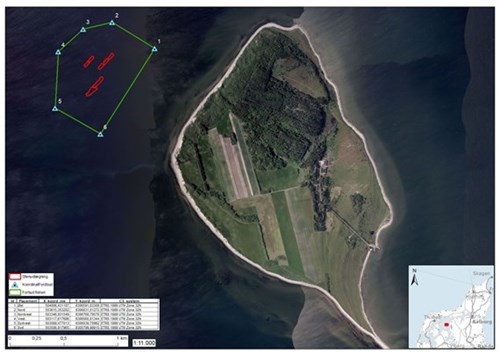
Northwest of Livø, a stone reef has been established to study the chemical and biological processes occurring on a newly formed reef and to examine how different oxygen and current conditions affect life on the reef.
In collaboration with the Danish Ministry of Environment and Food, Limfjordsrådet carried out a project investigating whether additional stone reefs in the Limfjord could improve oxygen conditions in the fjord and thereby reduce the release of nitrogen from the seabed. The project began in December 2015 and was completed at the end of 2021.
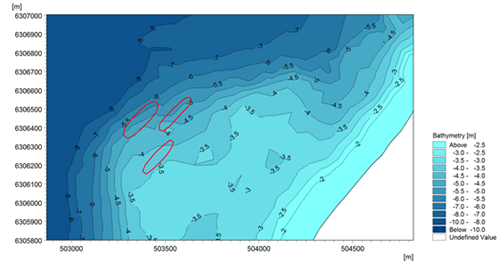
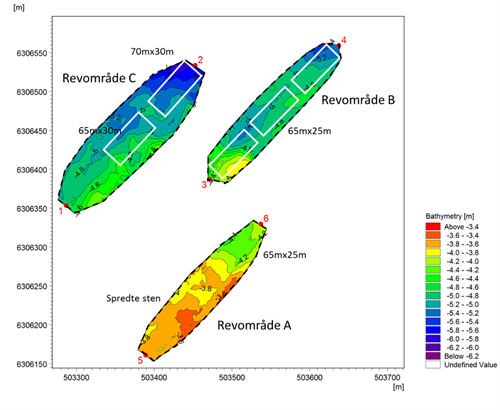
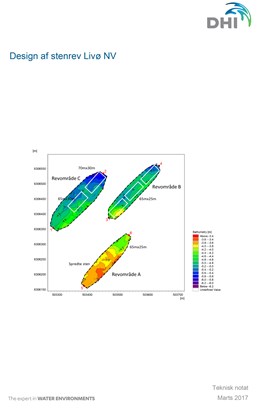
Figure 1a and 1b: Location and size of reef ridges in the reef areas (revområder). The outlines of the reef ridge footprints are indicated by white rectangles.
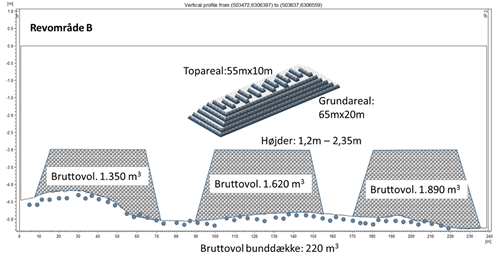
Figure 2: Longitudinal section through reef area B (between points 3 and 4 in Figure 1b), showing the seabed contour and the placement of reef ridges. The total volume of stones used for seabed coverage and reef ridges is indicated.
The main objective of the project was to investigate the potential nitrogen reduction effect of stone reefs in order to incorporate them as a possible supplementary measure in water management planning under the Water Framework Directive.
The project involved the establishment and analysis of a stone reef in Løgstør Bredning, as well as analyses of the nitrogen reduction potential of existing stone reefs. The project contributed to assessing whether stone reefs could be included as a nitrogen mitigation measure in the 2021–2027 water management plans and in achieving favorable conservation status for the Limfjord’s reefs.
More specifically, the project involved the construction of various reef formations in an area west of Livø at depths ranging from three to six meters. A wide range of physical, chemical, and biological studies were conducted on the newly established stone reef, as well as on and around existing reefs, to evaluate and document the potential nitrogen reduction effect of stone reefs.
The five-year project built upon previous model development and macroalgae mapping carried out in the Limfjord.
The project consisted of the following main deliverables:
Preliminary Study and Selection of Project Area
The first phase included baseline studies describing the existing conditions in Løgstør Bredning, including historical stone reef occurrences, current seabed and sediment conditions, light and oxygen levels, and overall environmental impacts on the area. It also determined the characteristics of the planned stone reef, including design, size, and material requirements. Based on these studies, the optimal location for the project was identified, and planning documents and necessary permits were obtained.
Construction of the Stone Reef
Once the project area was finalized, a detailed design phase was carried out, followed by a tendering process including the procurement of stones and other necessary materials, as well as supervision of the construction phase.
Macroalgal Response to Changing Living Conditions
This component examined how macroalgae on stone reefs respond to changes - particularly reductions in light availability - and their tolerance to low oxygen levels or periodic anoxic conditions. The study focused on dominant species found on existing stone reefs. The delivery provided the necessary data for models that simulate how reef communities respond to for example periods of low light, high temperatures, and poor oxygen conditions.
Studies on Existing Stone Reefs
On existing reefs, measurements were conducted to assess the exchange (flux) of oxygen and nutrients in and around the reefs, as well as the nutrient reservoirs in the sediment. Biodiversity monitoring was also carried out by examining the composition of colonizing organisms - both macroalgae and associated fauna, including fish and shellfish. The balance between vegetation and benthic fauna on hard substrates is a key factor in the overall oxygen budget.
Impact Studies on the New Stone Reef
Following the construction of the new reef, studies were conducted to assess its effects, both on and around the reef. These included measurements of oxygen and nutrient fluxes, as well as nutrient reservoirs in the sediment. Biodiversity monitoring focused on the composition of colonizing organisms - macroalgae and associated fauna (fish, shellfish, etc.). The balance between vegetation and benthic fauna on hard substrates is critical for the overall oxygen budget. For nitrogen reduction to be effective, it is essential that macroalgae establish themselves on the newly placed stones, as they produce the oxygen necessary for the desired nitrogen effect. Therefore, tests were conducted on different methods to promote macroalgae establishment and growth.
Analysis, Synthesis, and Recommendations
The project concluded with integrated model analyses, including modeling of oxygen production’s impact on nutrient release, to assess the potential of stone reefs to mitigate the negative effects of nitrogen inputs on the ecological condition of fjords and coastal waters. A final synthesis and set of recommendations were developed, including an evaluation of whether stone reefs are suitable as a mitigation measure.
AU, DHI, DTU Aqua, GEUS, NIVA Danmark and Limfjordsrådet.
1. The impact of new stone reefs on oxygen conditions in bottom waters and nitrogen cycling in the fjord seabed was found to be minimal.
2. If water clarity improves by approximately 40%, oxygen conditions near the seabed will improve, and the fjord's internal nitrogen load will decrease.
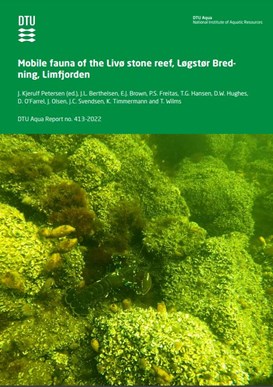
3. New stone reefs have a highly positive effect on biodiversity. Biomass on the newly established reef was 11 times higher than on the surrounding seabed.
The text is written by Torben Bramming Jørgensen, Project Manager at Limfjordsrådet
@ Torben.joergensen@aalborg.dk
#+4525202156