
Better BirdLIFE
"Improving Habitats for Coastal Birds in the Western Baltic Sea" aims to enhance the conditions for 10 breeding bird species and 4 migratory bird species in the western Baltic Sea. By focusing specifically on improving the habitats of these species, the project will also contribute to the enhancement of various natural habitats.
The project is carried out in collaboration between 9 partners, with Middelfart Municipality as the lead organization. The other partners include the Bird Protection Foundation (Fugleværnsfonden), the municipalities of Kerteminde, Kolding, Nordfyns, and Sønderborg, the Danish Nature Agency (Naturstyrelsen), Stiftung Naturschutz Schleswig-Holstein, and the University of Southern Denmark.
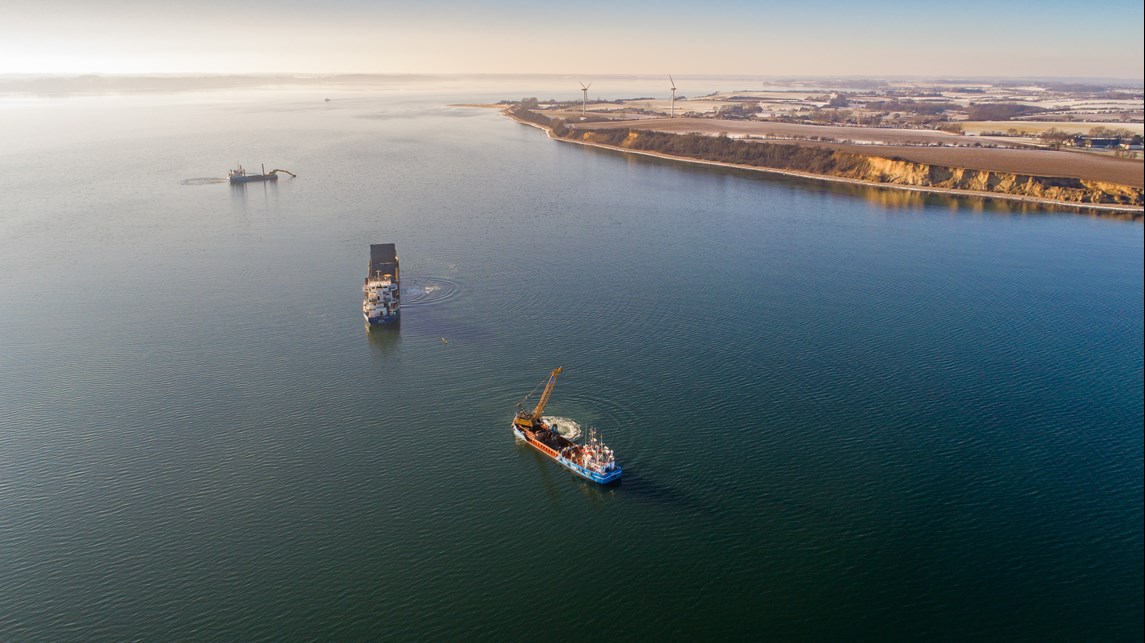
Deployment of stone reefs (Photo: Kim Toft Jørgensen, Sønderborg Municipality)
Western Baltic Sea with project areas in both Denmark and Germany.
The project implements various initiatives to improve breeding, resting, and foraging sites - both in coastal areas and in the water. The marine initiatives include the establishment of stone reefs and eelgrass meadows.
All measures are carried out within Natura 2000 areas to mitigate threats to bird species listed in the designation basis of these areas.
The common eider is included in the designation basis for both Littlebælt and Flensburg Fjord, where the lack of suitable foraging habitats has been identified as a threat to the species. The primary food source for the common eider is blue mussels. By establishing stone reefs, hard substrates are created where blue mussels can attach. At the same time, the stone reefs will serve as a habitat for various other species, contributing to increased biodiversity. Stone reefs are a designated habitat type in the Natura 2000 areas, and the project thus also improves the conservation status of this habitat.
The stone reefs have been built using quarried stones from Norway. The purchase and placement of the stones were conducted as a joint tender for the three participating municipalities, where bidders had to propose how much of the planned reefs they could establish at a fixed price.
The eelgrass meadows were established by the University of Southern Denmark (SDU) with the assistance of the two participating municipalities and volunteers, who helped prepare eelgrass shoots for planting.
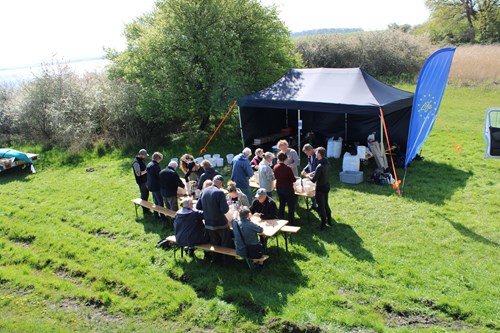
Volunteers tying eelgrass (Photo: Jakob Pedersen, Middelfart Municipality)
A baseline monitoring has been conducted at the stone reef locations, focusing on macroalgae and potential food sources for the project's target species, particularly blue mussels. Monitoring will continue throughout 2024.
Kristine Langager Jensen
Kristine.langagerjensen@middelfart.dk
Middelfart Municipality
See the project website: www.betterbirdlife.dk